

Anyone who has spent time around competitive sports has seen it happen. One athlete looks calm and composed in a high-stakes moment, while another suddenly looks tense, rushed, and unsure. The physical ability may be similar, but the outcome turns out very different. More often than not, the difference is mental strength.
Mental strength in sports training is not just about motivation or confidence. It’s about how the mind handles pressure when the stakes rise. Athletes who train their mental game learn to stay focused, regulate emotions, and execute their skills when it matters most. Over time, that ability becomes a powerful competitive advantage.
Why Mental Strength In Sports Training Matters During Pressure Moments
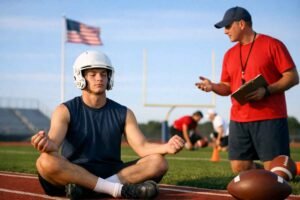
Pressure is a constant part of competitive sports. The score is close, the crowd is loud, and the clock is running down. In those situations, physical preparation alone is rarely enough.
Mental strength in sports training helps athletes interpret pressure differently. Instead of seeing the moment as a threat, mentally strong athletes see it as a challenge. That shift in mindset changes how the body reacts. Muscles stay relaxed, breathing stays controlled, and the athlete remains capable of executing skills with precision.
Without that mental conditioning, the opposite tends to happen. Athletes may overthink, tense up, or become distracted by the fear of failure. Even well-trained skills can suddenly break down under that kind of stress.
How The Mind Responds To High-Pressure Situations

Sports psychologists often describe pressure as a test of attention and emotional control. When stress rises, the brain naturally scans for threats. For athletes who have not trained their mental resilience, that reaction can quickly disrupt performance.
Mentally strong athletes, however, learn to control that response.
Several psychological factors shape performance in pressure situations:
- Facilitative stress appraisal – interpreting pressure as a challenge rather than a threat
- Task-focused attention – concentrating fully on the action instead of the outcome
- Emotional regulation – controlling physiological responses like heart rate and muscle tension
- Resilience after mistakes – quickly recovering from errors without losing confidence
These traits do not appear overnight. They develop through deliberate mental training alongside physical practice.
The Role Of Focus And Attention In Competitive Performance

One of the biggest advantages of mental strength in sports training is the ability to control attention. High-pressure environments come with constant distractions: crowd noise, opponent behavior, scoreboard pressure, and internal doubts.
Athletes with strong mental conditioning learn to narrow their focus to the immediate task. Instead of thinking about the final score or the consequences of a mistake, they direct their attention to the process.
A basketball player focuses on the shooting motion.
A pitcher focuses on the grip and release.
A tennis player focuses on footwork and ball contact.
This process-oriented focus prevents the mental overload that often causes athletes to “choke” under pressure.
Emotional Regulation And The Optimal Performance Zone

Another critical aspect of mental strength is emotional control. Every athlete performs best within a certain level of psychological arousal. Too little intensity leads to sluggish performance, while excessive stress leads to panic and poor decision-making.
Sports psychologists often refer to this as the optimal performance zone.
Athletes trained in mental skills learn to regulate their emotional state so they remain within this zone. Breathing techniques, focus cues, and controlled routines help stabilize the nervous system when adrenaline spikes.
When that balance is achieved, athletes can perform complex skills automatically, even in chaotic environments.
Mental Training Techniques Athletes Use

Mental strength does not develop by accident. Coaches and sports psychologists integrate specific mental training strategies into practice environments.
Some of the most widely used techniques include:
- Pressure training – introducing consequences or competition scenarios during practice so athletes become familiar with stress conditions
- Visualization – mentally rehearsing successful performance to build neural patterns for execution
- Positive self-talk – replacing negative thoughts with instructional or motivational cues
- Pre-performance routines – consistent physical or mental sequences performed before a skill
- Process-based goal setting – focusing on controllable actions rather than outcomes
These techniques gradually train the brain to respond calmly when pressure increases.
Why Experience Strengthens Mental Toughness

Athletes who compete at higher levels often demonstrate stronger mental resilience. Experience plays a major role in that development.
Repeated exposure to pressure situations helps athletes become comfortable with the emotional intensity of competition and burnout recovery. Over time, the nervous system adapts. Situations that once felt overwhelming begin to feel manageable.
Experienced competitors also develop practical coping strategies. They know how to reset after mistakes, refocus attention, and maintain confidence even when the momentum of a game shifts.
That accumulated experience is one reason elite athletes often appear calm in moments that feel overwhelming to less experienced competitors.
Why Mental Strength In Sports Training Is Now A Core Part Of Coaching

Modern coaching increasingly recognizes that physical training alone is incomplete without psychological preparation. Many training programs now include structured mental conditioning alongside strength, skill, and endurance training.
This shift reflects a simple reality: when two athletes have similar physical abilities, the one with stronger mental skills often performs better when pressure rises.
Mental strength in sports training equips athletes with the focus, emotional control, and resilience needed to deliver their best performance when the stakes are highest.
FAQs: How Mental Strength In Sports Training Shapes Performance Under Pressure
1. What Is Mental Strength In Sports Training?
Mental strength in sports training refers to the psychological skills athletes develop to maintain focus, confidence, and emotional control during training and competition.
2. Can Mental Toughness Be Trained?
Yes. Mental toughness can be developed through structured techniques such as visualization, pressure training, goal setting, and self-talk.
3. Why Do Some Athletes Choke Under Pressure?
Athletes often struggle under pressure when anxiety disrupts focus and muscle coordination. Mental training helps athletes manage these stress responses.
4. Do Elite Athletes Train Mental Skills Regularly?
Most elite athletes incorporate mental training into their preparation. Techniques such as visualization, routines, and attention control are commonly practiced.
Final Thoughts
Mental strength in sports training plays a decisive role when competition intensifies. Physical preparation builds the foundation, but the ability to manage pressure ultimately determines how effectively those skills are executed. Athletes who invest time in mental conditioning develop the focus, emotional stability, and resilience needed to handle demanding situations without losing control of their performance.
Over time, that psychological edge becomes one of the most valuable tools an athlete can develop.